
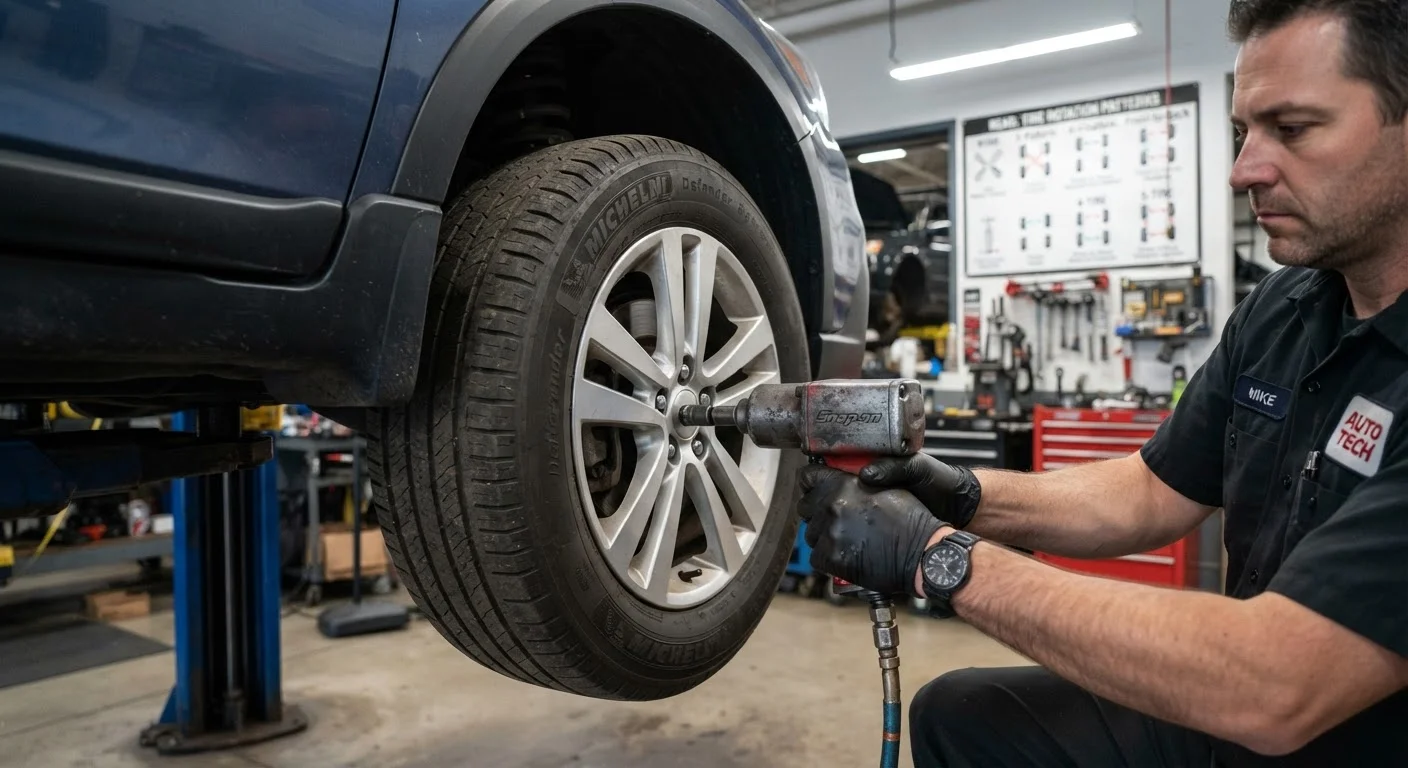
What Tire Rotation Actually Does
Tire rotation is exactly what it sounds like: moving each tire from one position on the vehicle to another in a specific pattern. The goal is to ensure that all four tires wear down at roughly the same rate over time.
Why does position matter? Because different corners of a vehicle place different demands on a tire. On a front-wheel-drive car, the front tires manage steering, acceleration, and a significant share of braking - meaning they wear considerably faster than the rear tires. Rotating them periodically - typically in a front-to-rear or cross pattern depending on whether the tires are directional - spreads that workload around.
Most vehicle manufacturers recommend rotation every 5,000 to 7,500 miles, often conveniently aligned with oil change intervals. The specific pattern (straight swap, cross pattern, or a five-tire rotation including a full-size spare) depends on the drivetrain and tire type. Check your owner's manual for the recommended pattern for your vehicle.
See our guide on DIY vs. shop maintenance to understand whether rotating tires yourself is a realistic option - it generally requires a floor jack, jack stands, and a torque wrench.
What Wheel Balancing Actually Does
Wheel balancing addresses a fundamentally different problem: uneven weight distribution within a tire-and-wheel assembly. Even a brand-new tire mounted on a new rim will have slight variations in mass due to manufacturing tolerances. When a wheel spins at highway speed, those imbalances create vibration.
A technician performs balancing by mounting the assembly on a spin-balancer machine, which identifies exactly where and how much weight compensation is needed. Small counterweights - typically clip-on or adhesive - are then attached to the rim at specific points to neutralize the imbalance.
| Criterion | Tire Rotation | Wheel Balancing |
|---|---|---|
| What it corrects | Uneven tread wear across positions | Uneven weight in wheel assembly |
| Primary symptom | Faster wear on specific tires | Vibration at highway speeds |
| Typical interval | Every 5,000-7,500 miles | When symptoms appear; with new tires |
| Equipment used | Jack, jack stands, torque wrench | Spin-balancer machine, counterweights |
| DIY-friendly? | Possible with proper tools | No - requires shop equipment |
| Affects ride quality? | Indirectly, over time | Yes, directly and immediately |
Common triggers for wheel balancing include: new tire installation, hitting a significant pothole or curb, feeling persistent vibration at speeds above 50 mph, or noticing scalloped (cupped) wear patterns on the tread. Balancing is also advisable any time a tire is dismounted and remounted.
How to Tell Which Service You Actually Need
The symptoms of each issue tend to be distinct, which makes it relatively straightforward to identify the likely culprit before you visit a shop.
- Uneven tread depth across different tires - typically a rotation issue. If the front tires are noticeably more worn than the rear, the rotation schedule has been neglected.
- Vibration felt in the steering wheel or seat at highway speeds - typically a balancing issue. The vibration often appears at a specific speed range and worsens as speed increases.
- Cupping or scalloping on the tread surface - can indicate balancing problems, though worn shocks or struts can produce the same pattern.
- All tires wearing evenly but faster than expected - may point to inflation problems, alignment issues, or driving habits rather than rotation neglect.
It's worth noting that neither service substitutes for a wheel alignment, which is a third and separate procedure that corrects the angle at which tires meet the road. Alignment problems can cause pulling, steering drift, and angled wear - symptoms that rotation and balancing won't fix.
Don't Confuse These with Wheel Alignment
Alignment adjusts the angle and direction your tires point relative to the road and to each other - it's a distinct procedure from both rotation and balancing. If your vehicle pulls to one side or your steering wheel sits off-center while driving straight, alignment is the service to ask about. All three services are complementary but address separate issues.