
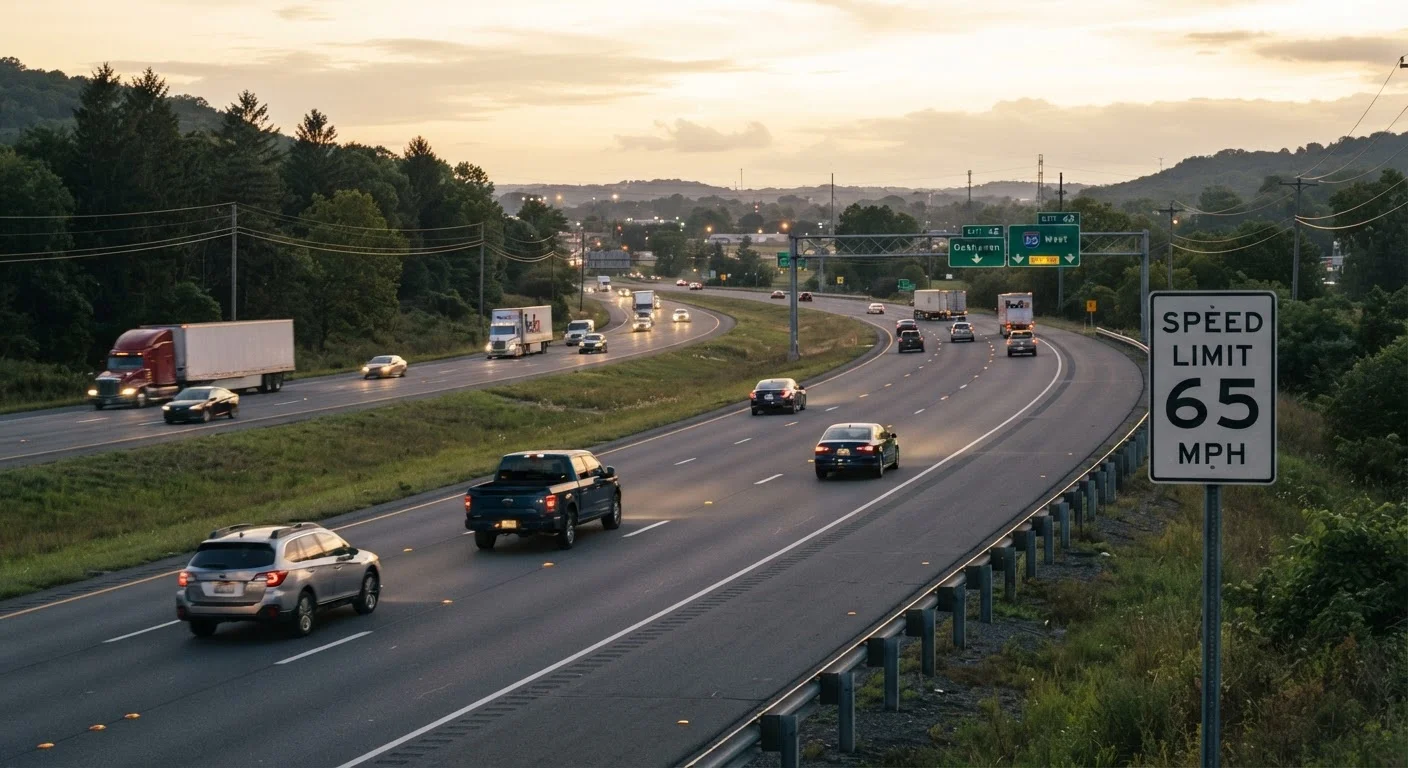
The Purpose Behind Posted Speed Limits
Speed limits exist to balance two competing realities: the desire for efficient travel and the need to keep roads safe for everyone using them - drivers, passengers, cyclists, and pedestrians alike. A road without any speed standard would be unpredictable and dangerous. A road with an unreasonably low limit would impede traffic flow and potentially encourage risky passing maneuvers.
The goal of a well-set speed limit is to reflect the speed at which the majority of careful drivers would naturally travel under ideal conditions - a number that is both enforceable and grounded in the physical reality of the road itself. Speed limits are also designed to reduce the consequences when something goes wrong. Physics determines how crashes unfold: a pedestrian struck at 40 mph faces a dramatically higher fatality risk than one struck at 20 mph. Setting appropriate limits is one of the most direct tools traffic safety professionals have.
How Speed Limits Are Actually Determined
Contrary to popular assumption, speed limits are not pulled from thin air or set by political convenience. Traffic engineers use a structured process that typically includes several key steps.
Traffic Speed Studies
Engineers conduct what are called speed studies - measurements of how fast vehicles actually travel on a stretch of road when drivers feel free to choose their own comfortable speed. This data forms the foundation of limit-setting.
The 85th Percentile Benchmark
One widely applied principle is the 85th percentile rule: the speed at or below which 85 percent of vehicles travel on a given road is considered a reasonable upper boundary for the posted limit. The rationale is that this speed represents the practical consensus of experienced, attentive drivers on that road under good conditions.
Road and Environmental Factors
Engineering analysis also accounts for road geometry (curves, hills, sight distance), pavement condition, lane width, the presence of driveways or intersections, and surrounding land use. A four-lane divided highway with wide lanes and clear sightlines warrants a higher limit than a narrow residential street with frequent pedestrian crossings.
~29%
Share of U.S. traffic fatalities involving speeding
According to NHTSA data, speeding is consistently identified as a factor in roughly one-quarter to one-third of fatal motor vehicle crashes annually.
85th
Percentile speed used as engineering baseline
Traffic engineers commonly use the speed at which 85 percent of drivers naturally travel as a key reference point when evaluating or setting posted limits.
2x+
Stopping distance increase from 30 to 60 mph
Because stopping distance increases with the square of speed, doubling your speed more than quadruples the energy that must be absorbed in a crash, per basic physics principles applied in traffic safety research.
Crash History and Safety Data
If a corridor has an elevated history of crashes - particularly severe or fatal ones - engineers and policymakers may set limits lower than the 85th percentile speed to provide an additional safety margin. Safety data is a legitimate and important override to purely speed-based analysis.
What Happens When Drivers Ignore Speed Limits
Speeding is among the most consistently documented contributors to traffic fatalities in the United States. According to the National Highway Traffic Safety Administration (NHTSA), speeding has been a factor in roughly one-third of all motor vehicle traffic fatalities in recent years.
The consequences of speed extend beyond legal penalties. At higher speeds, a driver's stopping distance increases substantially - sometimes by more than drivers expect. A vehicle traveling at 60 mph requires significantly more distance to come to a complete stop than one traveling at 40 mph. Reaction time becomes a critical limiting factor, and the energy transferred in a collision increases with the square of speed, meaning crashes at higher speeds are exponentially more destructive.
Beyond individual crashes, widespread speeding affects entire communities. It raises noise levels, increases fuel consumption, and creates hostile conditions for pedestrians and cyclists - particularly in residential and mixed-use areas.
Speed Limits Are Not Static
Speed limits are revised regularly in response to changing conditions. Road reconstruction, new developments, rising crash rates, or shifts in traffic volume can all trigger a review. Some states have moved to lower default urban speed limits in recent years following evidence that lower speeds in dense areas reduce pedestrian fatalities. Others have raised limits on rural interstates after studies showed driver behavior had changed.
Understanding that speed limits are the product of an evidence-based process - rather than bureaucratic caprice - can help drivers approach them as meaningful safety guidance rather than obstacles to ignore. When you see a posted limit, it reflects the studied judgment of engineers about what speeds that particular road can safely accommodate.
This article is for general informational and educational purposes only. For specific legal questions about traffic laws in your state, consult a qualified legal professional or your state's department of motor vehicles.