
How Each Account Is Taxed
The core difference between a Roth IRA and a Traditional IRA is simple: when you get your tax benefit.
With a Roth IRA, you contribute money that you've already paid income tax on - after-tax dollars. In exchange, your investments grow tax-free, and qualified withdrawals in retirement (generally after age 59½, with the account open at least five years) are completely tax-free. You won't owe the IRS a cent on those earnings when you take them out.
With a Traditional IRA, you may be able to deduct your contributions from your taxable income in the year you make them - giving you an upfront tax break. Your money then grows tax-deferred. When you withdraw funds in retirement, those distributions are taxed as ordinary income at whatever rate applies to you then.
Think of it this way: the Roth IRA is a deal where you pay the tax bill now and never again. The Traditional IRA is a deal where you delay the bill until retirement. Neither is inherently better - the right choice depends on how those two tax moments compare for you personally.
| Criterion | Roth IRA | Traditional IRA |
|---|---|---|
| Tax treatment of contributions | After-tax (no deduction) | Pre-tax (may be deductible) |
| Tax treatment of withdrawals | Tax-free (if qualified) | Taxed as ordinary income |
| Income limits to contribute | Yes - phases out at higher incomes | No limit to contribute; deduction phases out |
| 2024 contribution limit | $7,000 ($8,000 if 50+) | $7,000 ($8,000 if 50+) |
| Required Minimum Distributions | None during owner's lifetime | Required starting at age 73 |
| Early withdrawal of contributions | Anytime, penalty-free | Subject to tax and 10% penalty |
| Best tax environment to use | When tax rate is low now, higher later | When tax rate is high now, lower later |
Eligibility, Contribution Limits, and Income Rules
For the 2024 tax year, both account types share the same annual contribution limit: $7,000, or $8,000 if you're age 50 or older (the IRS refers to the additional amount as a "catch-up contribution"). You cannot contribute more than your earned income for the year.
Roth IRA income limits: The ability to contribute to a Roth IRA phases out at higher income levels. For 2024, the phase-out range is $146,000-$161,000 for single filers and $230,000-$240,000 for married filing jointly. Above these thresholds, direct Roth IRA contributions are not permitted. (A strategy called the "backdoor Roth" exists for higher earners, but it involves specific steps and tax considerations - consult a qualified financial professional before attempting it.)
Traditional IRA deductibility limits: Anyone with earned income can contribute to a Traditional IRA, but the tax deduction may be limited if you or your spouse participate in a workplace retirement plan (such as a 401(k)) and your income exceeds certain thresholds. If you're covered by a workplace plan, the deduction phases out between $77,000 and $87,000 for single filers and between $123,000 and $143,000 for married filing jointly in 2024. Even if your contribution isn't deductible, you can still make a non-deductible Traditional IRA contribution, though tax-free growth is a key advantage of the Roth in that case.
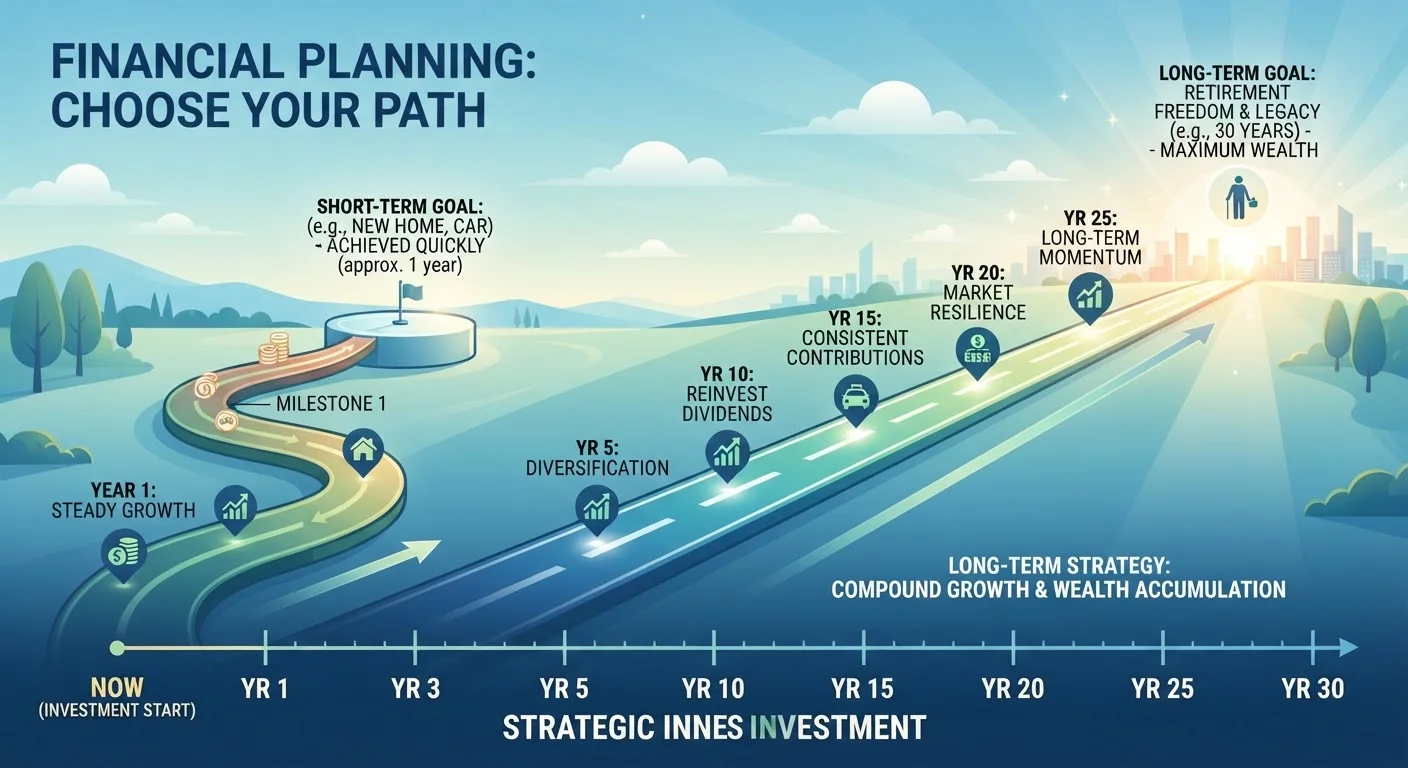
Understanding your time horizon and investment timeline is essential context when evaluating which account fits your situation.
Required Minimum Distributions and Withdrawal Rules
One practical distinction that matters more as you near retirement is the Required Minimum Distribution (RMD) rule. Under current IRS rules, Traditional IRA owners must begin taking minimum withdrawals each year starting at age 73. These withdrawals are calculated based on your account balance and life expectancy tables published by the IRS. Failing to take an RMD triggers a significant penalty.
Roth IRAs have no RMDs during the original owner's lifetime. You can leave your money untouched as long as you like, letting it continue to grow tax-free - a meaningful advantage if you don't need the funds immediately or want to pass assets to heirs.
On early withdrawals: both account types charge a 10% early withdrawal penalty if you take money out before age 59½, with certain exceptions (disability, first-time home purchase up to a $10,000 lifetime limit, and others). However, because Roth IRA contributions - not earnings - were already taxed, you can withdraw your contributions (not growth) at any time, penalty- and tax-free. Traditional IRA withdrawals before 59½ are generally subject to both income tax and the 10% penalty.
Roth IRA Five-Year Rule
To take tax-free withdrawals of earnings from a Roth IRA, two conditions must be met: you must be at least 59½, and your Roth IRA must have been open for at least five tax years. The five-year clock starts on January 1 of the first tax year for which you made a Roth IRA contribution - not the calendar date of your first deposit. This rule applies separately to conversions, so if you convert a Traditional IRA to a Roth, a new five-year clock begins for that converted amount.
When thinking about tax-advantaged accounts alongside your broader savings picture, it helps to consider how automating your savings contributions can keep you on track without relying on willpower alone.
Which Account Is the Right Fit?
The honest answer is: it depends on your current tax rate versus your expected tax rate in retirement. If you believe you'll be in a higher bracket later - common for younger earners or those early in their careers - paying taxes now via a Roth generally makes mathematical sense. If you're in a higher bracket today and expect lower income in retirement, deferring taxes through a Traditional IRA is usually more efficient.
For those with genuine uncertainty (which describes many people), some financial educators suggest splitting contributions between both account types in different years, or using one alongside an employer-sponsored plan. This can provide tax diversification - meaning you'll have both taxable and tax-free income sources to draw from in retirement, giving you flexibility to manage your tax burden. This is general information; a licensed financial adviser can help you model your specific situation.
Whatever account structure you choose, the fundamentals of what you invest in matter too. Our overview of index funds versus actively managed funds can help you think through what to hold inside your IRA once you've opened one.
This article is for general informational and educational purposes only and does not constitute personalized financial, tax, or investment advice. Tax rules and contribution limits are subject to change. Consult a qualified financial adviser, tax professional, or accountant for guidance specific to your situation.