How Each Method Works
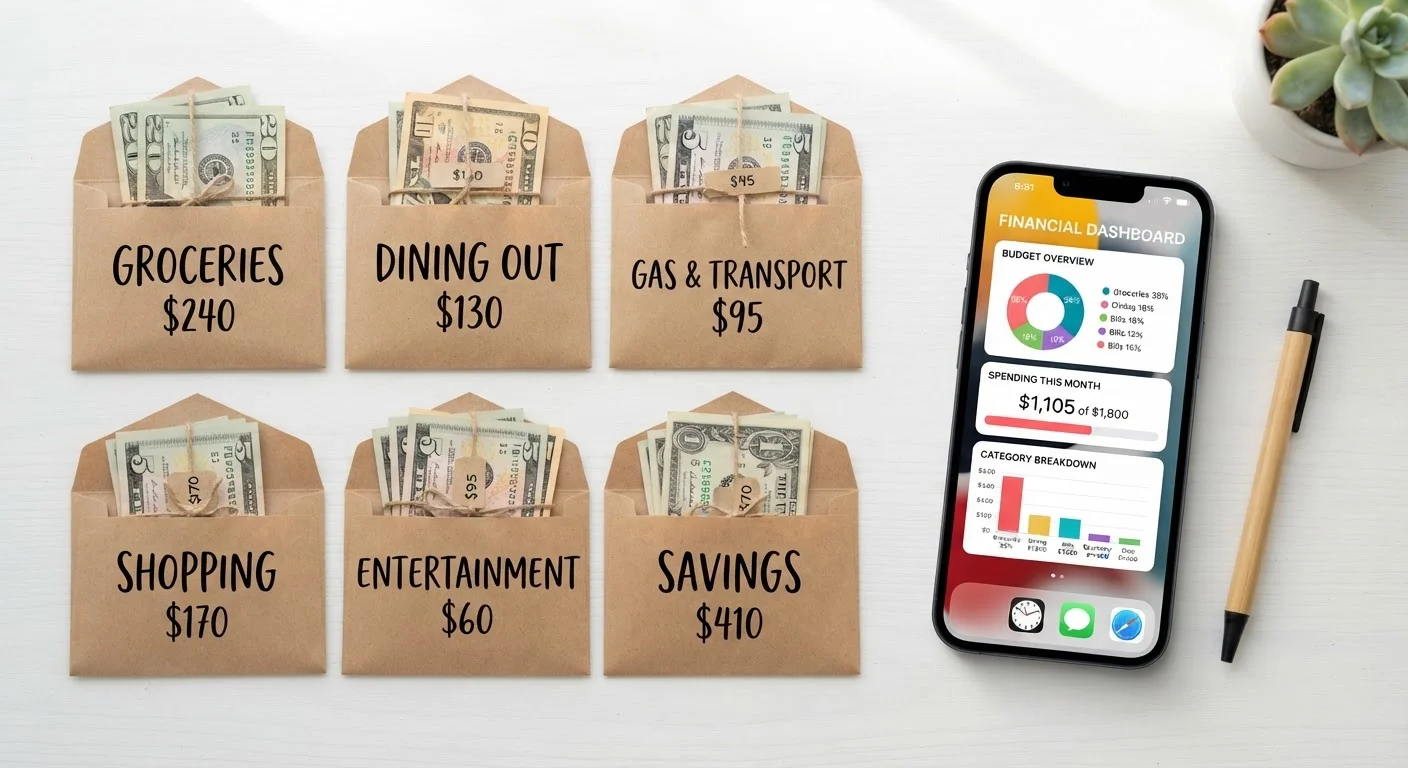
Envelope budgeting is a cash-allocation system with roots in early-20th-century household money management. At the start of each pay period, you withdraw cash and divide it into labeled envelopes - one per spending category, such as groceries, gas, or dining out. When an envelope runs out, spending in that category stops until the next cycle. There is no overdraft, no credit line, and no ambiguity.
Digital spending trackers, by contrast, operate by linking to your checking, savings, and credit card accounts via secure banking connections. The app pulls in transactions automatically, assigns them to categories, and displays your remaining balance against whatever budget you've set. Some apps send alerts when you approach a category limit; others let you set spending goals and track progress visually over time.
Both approaches answer the same core question - where is my money going? - but through fundamentally different mechanisms: one through physical constraint, the other through informational transparency.
Key Differences at a Glance
Understanding the structural differences between these methods helps you predict which will fit your actual habits rather than an idealized version of them.
| Criterion | Envelope Budgeting | Digital Spending Trackers |
|---|---|---|
| Primary mechanism | Physical cash allocation | Automated transaction categorization |
| Spending enforcement | Hard stop when envelope empties | Alerts and visual cues only |
| Setup complexity | Low - cash, envelopes, pen | Moderate - account linking, categories |
| Coverage of expenses | Cash-payable categories only | All accounts and transaction types |
| Ongoing time commitment | Moderate - manual cash management | Low - largely automated tracking |
| Spending data and reports | Manual records only | Automated history and trend analysis |
| Privacy considerations | No third-party data sharing | Requires sharing bank credentials |
| Best fit for | Discretionary, variable categories | Whole-household financial overview |
One distinction worth highlighting: envelope budgeting works only for cash-payable expenses. Rent, online subscriptions, utility autopay, and loan installments can't realistically go in a physical envelope. This limits the system's coverage unless you supplement it with written records for fixed costs - which adds friction. Digital trackers capture every transaction type automatically, making them more comprehensive by default.
For a broader look at how different budgeting frameworks compare structurally, see our comparison of zero-based and percentage-based budgeting.
The Psychology Behind Each Approach
Research in behavioral economics consistently shows that payment method affects spending behavior. Studies have found that people tend to spend more freely with cards than with cash - a phenomenon sometimes called the "pain of paying." Physical cash registers as a real loss in a way that a card swipe often does not, which is precisely why envelope budgeting can work well for variable, discretionary categories like groceries or entertainment.
Digital trackers operate on a different psychological lever: awareness. When an app shows you that you've spent 80% of your dining budget by the second week of the month, that visibility can prompt a behavioral correction - but only if you check the app regularly and take the data seriously. The system doesn't stop you from spending; it informs you.
This distinction matters. If you tend to rationalize or delay reviewing financial data, a tracker may not provide the hard stop you actually need. If cash management feels impractical for your lifestyle, the friction of the envelope method may cause you to abandon it within weeks. Our article on building a budgeting habit that actually sticks explores the behavioral side of this in more depth.
Practical Considerations and a Hybrid Path
Before choosing a method, consider your actual spending patterns. Do you pay most bills electronically? Do you carry cash regularly? Do you prefer reviewing a dashboard or prefer a hands-on, tangible process? Honest answers to these questions matter more than which method is theoretically superior.
A hybrid approach is also worth considering. Some households use digital trackers for fixed and online expenses while maintaining cash envelopes for volatile categories like groceries and personal spending money. This captures the oversight benefits of technology while preserving the hard constraint that cash provides where overspending is most common.
Whichever method you choose, be aware that most budgets underestimate certain categories - irregular costs like car maintenance, medical copays, or annual subscriptions are frequently left out. Our piece on spending categories most budgets underestimate can help you build a more complete category list before you start. And once your system is running, a regular monthly review - whether of your envelopes or your app dashboard - is essential to course-correct over time. See our monthly budget reset checklist for a structured way to do this.
This article is for general informational and educational purposes only and does not constitute personalized financial advice. Consult a qualified financial professional for guidance specific to your situation.