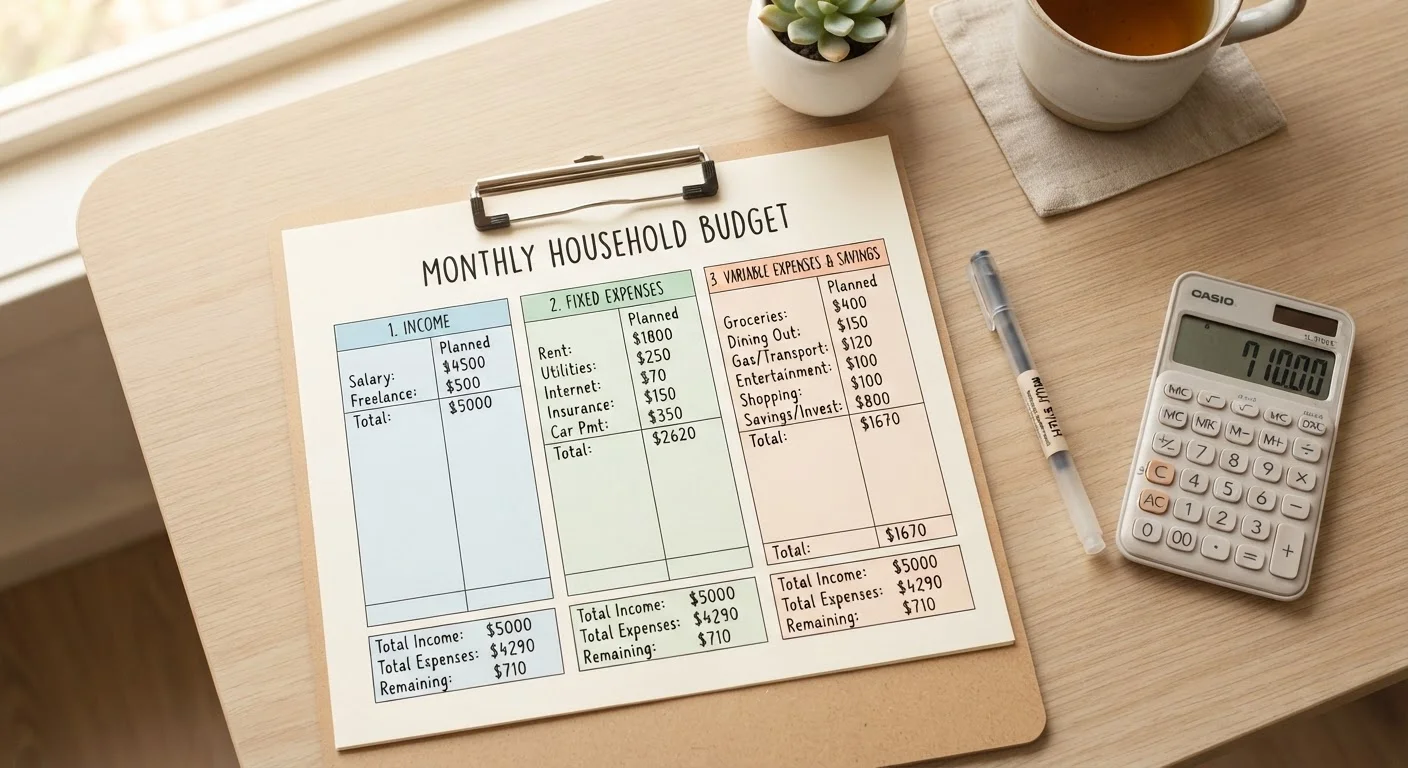

How Each Method Works
Zero-based budgeting (ZBB) starts with your total monthly income and requires you to assign every dollar to a category - housing, groceries, savings, debt payments, subscriptions - until the remaining balance equals zero. That zero doesn't mean you've spent everything; it means every dollar has a job, including dollars earmarked for savings or an emergency fund.
Percentage-based budgeting works differently. You divide your income into broad buckets defined by fixed percentages. The widely referenced 50/30/20 rule, for example, allocates roughly 50% to needs, 30% to wants, and 20% to savings and debt repayment. You can read a deeper breakdown in The 50/30/20 Rule: What It Is and When It Actually Works. Other percentage frameworks exist, but the principle is the same: proportional allocation rather than line-by-line accounting.
Both methods share the same fundamental goal - spending intentionally - but they take meaningfully different paths to get there.
| Criterion | Zero-Based Budgeting | Percentage-Based Budgeting |
|---|---|---|
| Core mechanic | Assign every dollar to a category | Split income by fixed percentages |
| Monthly setup time | Higher - rebuilt each month | Lower - percentages stay constant |
| Flexibility for irregular income | High - rebuilt from actual earnings | Moderate - averages can mislead |
| Level of spending detail | Granular, line-by-line | Broad category buckets |
| Best for beginners? | Steeper learning curve | Easier starting point |
| Debt payoff focus | Easily prioritized by design | Depends on how categories are set |
| Risk of overspending within category | Lower - tightly defined limits | Higher - broad buckets can hide leaks |
Strengths and Limitations of Each Approach
Zero-based budgeting strengths: It forces a thorough review of every spending category each month, which can surface expenses you had forgotten or underestimated. Research from the Association for Financial Counseling and Planning Education suggests that detailed tracking is associated with better short-term financial outcomes, though individual results depend heavily on follow-through. ZBB also makes it easier to redirect money with intention - a surplus in one category can be consciously shifted to debt payoff or savings.
Zero-based budgeting limitations: It is time-intensive. Setting up and reconciling a zero-based budget can take 30-60 minutes per month at minimum, and more if your spending is complex. It can also feel rigid, which may discourage beginners. For a candid look at what stops most people before they start, see Budgeting Myths That Keep People From Starting.
Percentage-based budgeting strengths: Simplicity and adaptability. Because the percentages scale with income, the framework stays relevant whether you earn $3,000 or $7,000 a month. It also requires less monthly maintenance - once you know your percentages, the budget largely runs itself.
Percentage-based budgeting limitations: Broad categories can mask problem spending. If your "needs" bucket is overfull, a percentage framework may not prompt you to investigate why. It also may not work well for people with highly irregular incomes, since percentages based on an average can be misleading in low-earning months.
Choosing the Right Method for Your Life
Neither method is objectively superior - the right choice depends on your income pattern, your tolerance for detail, and your current financial priorities. If you are just starting out, a percentage-based approach is generally easier to adopt. Once you have the habit in place, you can layer in more granular tracking. If you need to claw back control over runaway spending or are working through a debt payoff plan, zero-based budgeting's precision is a practical advantage.
Some people use a hybrid: percentage buckets as guardrails, with line-item tracking inside each bucket. This can offer the best of both worlds for those who want structure without obsessing over every transaction.
Whichever method you choose, the mechanics matter less than consistency. Building a Budgeting Habit That Actually Sticks offers evidence-informed strategies for making any method durable over time. Also worth reviewing: Spending Categories Most Budgets Underestimate, since overlooked expenses can derail even a well-structured plan. If you have never built a budget before, Your First Real Budget: A Plain-English Starting Point is a practical first step regardless of which approach you ultimately prefer.
This article is for general informational and educational purposes only and does not constitute personalized financial advice. Please consult a qualified financial professional for guidance tailored to your individual circumstances.