
What Time Horizon Actually Means
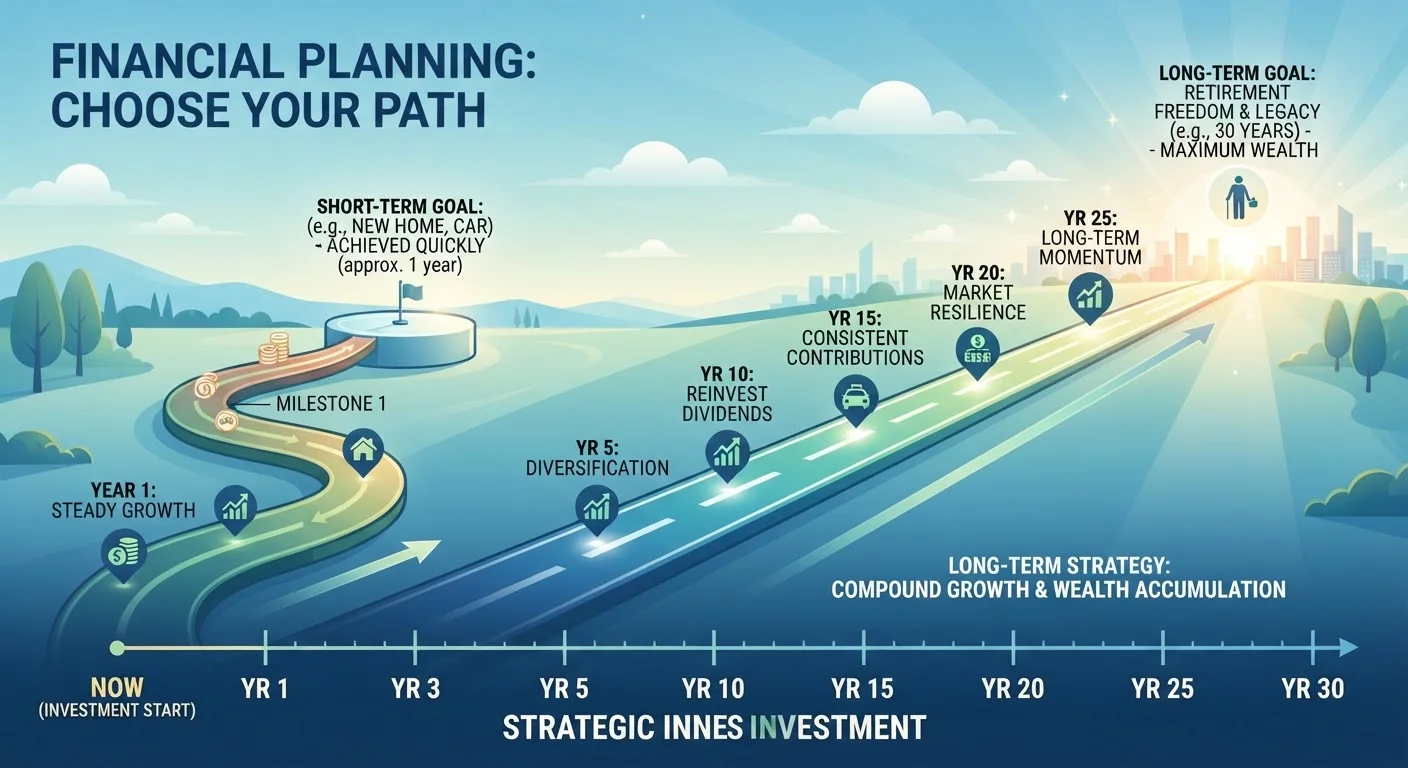
When financial educators talk about time horizon, they're asking a simple question: how long before you need this money? If you're saving for a vacation next year, your horizon is short - roughly twelve months. If you're contributing to a retirement account in your 30s, your horizon might be 25 to 35 years away.
That gap matters enormously because it determines how much volatility you can reasonably absorb. Markets fluctuate. Stocks can drop 20%, 30%, or more in a given year. If you need the money next year, a sharp drop could be devastating. If you don't need it for 30 years, the same drop is much less consequential - history shows markets have recovered from downturns over longer periods, though past performance does not guarantee future results.
It's also worth recognizing that you likely have multiple time horizons at once. You might be saving for a car down payment in two years, a home purchase in eight years, and retirement in 28 years - each goal calls for a different approach. See our guide to structuring short- and long-term savings goals for a deeper look at managing this complexity.
Why Short Horizons Demand a Different Strategy
When you need money within a few years, the priority shifts from growth to preservation. The risk of investing aggressively over a short period is straightforward: markets can decline sharply, and you might not have enough time for a recovery before you need to withdraw.
For short-term goals, financial educators commonly point to lower-volatility, more liquid options - such as federally insured savings accounts or short-duration fixed-income instruments - rather than stock-heavy portfolios. The trade-off is accepting lower potential returns in exchange for stability and accessibility.
Build Your Emergency Fund Before Investing
Before committing money to investments, most financial educators recommend having three to six months of essential expenses in a liquid, accessible account. Without this cushion, an unexpected expense could force you to sell investments at a loss to cover costs - effectively undermining your long-term strategy. Think of liquid savings as the foundation your investment plan rests on.
This connects directly to why having an emergency fund before investing is so important. If you have liquid savings to cover unexpected costs, you won't be forced to sell investments at an inopportune time. Our article on what an emergency fund has to do with investing explains how these two goals interact.
The Long-Horizon Advantage - and Its Limits
A long time horizon is genuinely powerful, primarily because of how compounding works. Returns earned early in your investment timeline can themselves generate returns, and over decades this effect compounds substantially. Our article on compound interest and long-term wealth explains this dynamic in plain terms.
10%
Average annual U.S. stock market return (historical, nominal)
The S&P 500 has historically averaged roughly 10% annually before inflation over long periods, though individual years vary dramatically and past performance does not guarantee future results.
~20%
Typical peak-to-trough drop in a bear market
The standard definition of a bear market is a decline of 20% or more from a recent high; recovery timelines have varied from months to several years depending on the downturn.
3-10 yrs
Typical medium-term investment horizon
Financial planning frameworks commonly categorize goals requiring funds in three to ten years as medium-term, warranting a balanced approach between growth and stability.
Long horizons also give investors more capacity to weather volatility. A portfolio heavy in equities (stocks) may experience dramatic swings year to year, but over multi-decade periods, the historical range of outcomes has been broader on the upside. That said, no outcome is guaranteed, and markets can underperform for extended periods.
One often-overlooked risk of long horizons: inflation. Leaving money in very low-yield accounts for 20 years while inflation runs above that rate erodes real purchasing power. Our piece on inflation's impact on savings and investments over time covers this in detail.
As your horizon shortens - say, when retirement shifts from 25 years away to 5 years away - it's common practice to gradually reduce exposure to volatile assets. This is sometimes called a glide path. The goal is to protect accumulated gains as the date you'll need the money approaches.
Time Horizon Is the Starting Point, Not the Whole Picture
Time horizon is one of the most important inputs into any investment strategy, but it doesn't work alone. It interacts with your risk tolerance (how comfortable you are with potential losses), your liquidity needs (whether you might need the money unexpectedly), and the level of diversification in your portfolio.
Think of it as a filter, not a prescription. Knowing your horizon helps you rule out strategies that are clearly mismatched - like putting a two-year house down payment into a highly volatile stock fund - and helps you identify the general territory of options worth exploring.
If you're new to investing and trying to apply these concepts for the first time, our grounded guide for first-time investors can help translate fundamentals into a starting framework.
This article is for general informational and educational purposes only and does not constitute personalized financial, investment, or tax advice. Consult a qualified, licensed financial adviser before making decisions about your own investments.