How Compound Interest Actually Works
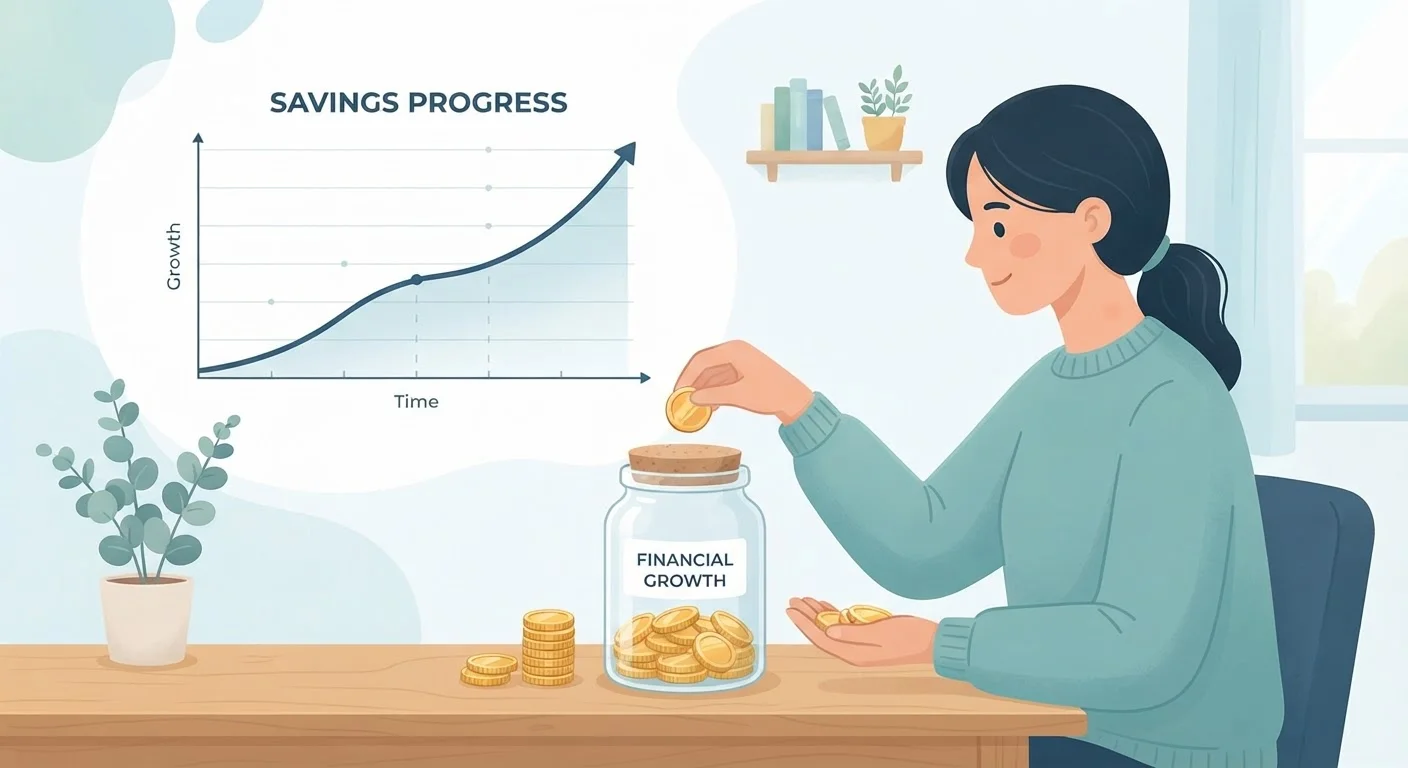
Think of compound interest as interest that feeds on itself. When you deposit money in a savings account, the bank pays you interest. The next time interest is calculated, it's applied to your new, slightly larger balance - not just the original deposit. That cycle repeats, and each period your balance grows by a little more than the period before.
Here's a simple illustration. Suppose you deposit $1,000 at a 5% annual interest rate:
- Year 1: You earn $50 in interest. Balance: $1,050.
- Year 2: You earn 5% on $1,050, or $52.50. Balance: $1,102.50.
- Year 10: Without adding another dollar, your balance reaches approximately $1,629.
- Year 30: That same $1,000 grows to roughly $4,322.
No additional contributions were made - only the original $1,000. The extra growth comes entirely from interest compounding on itself year after year.
$4,322
Growth of $1,000 over 30 years at 5% annual compound interest
Illustrative calculation assuming no additional contributions and annual compounding; actual results vary by rate and frequency.
~10x
Approximate S&P 500 price increase over the past 30 years
Historical index performance does not guarantee future results; figures are illustrative of long-term compounding potential in equity markets.
72
The "Rule of 72": years to double money = 72 ÷ annual rate
A common financial planning approximation - at 6% annual return, money roughly doubles every 12 years; at 4%, every 18 years.
Why Time Is the Critical Variable
The single most important factor in compounding is time. The math rewards patience in a way that feels almost counterintuitive at first.
Consider two savers. The first starts investing $200 a month at age 25 and stops at age 35 - a total of $24,000 contributed. The second waits until age 35 and invests $200 a month all the way to age 65 - a total of $72,000 contributed. Assuming the same average annual return, the first saver often ends up with a larger balance at retirement, simply because their money had more years to compound.
This is sometimes called the first-mover advantage of compounding: decades of growth can outweigh a larger total dollar amount invested later. It's the core argument behind starting to save and invest as early as possible, even in modest amounts.
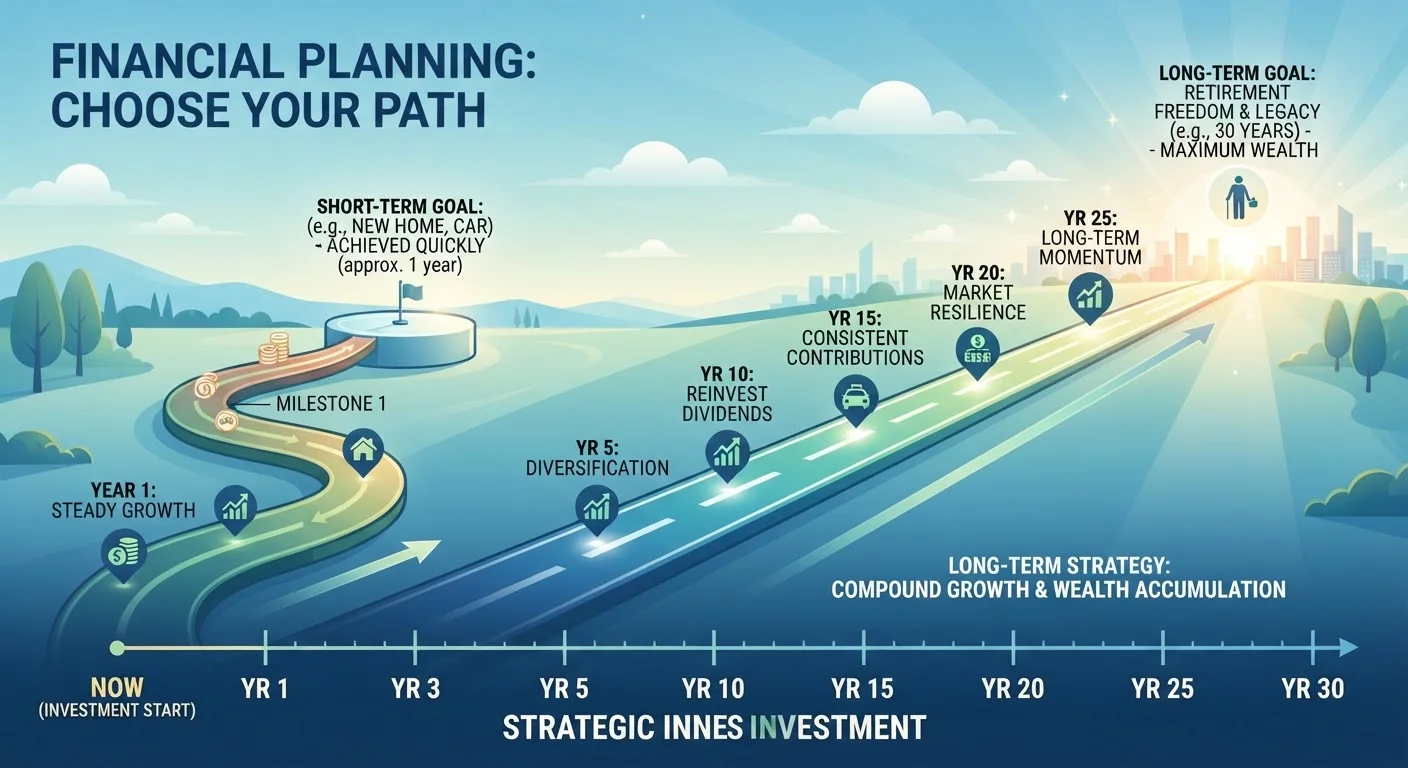
Your investment time horizon - how long you plan to keep money invested - directly shapes how much compounding can do for you. A 30-year horizon creates dramatically different outcomes than a 5-year one.
Where Compounding Shows Up in Real Life
Compound interest isn't abstract - it operates inside many everyday financial products.
Savings accounts: High-yield savings accounts pay interest that compounds daily or monthly, meaning even parked cash earns incrementally more than a simple interest account at the same rate.
Retirement accounts: A 401(k) plan allows contributions to grow without annual tax on interest or gains. Because taxes don't reduce the balance each year, a larger amount remains available to compound - amplifying the effect significantly over decades.
Investment portfolios: Reinvested dividends from stocks or bond funds function similarly to compound interest. When dividends buy more shares, those shares generate their own future dividends, creating a self-reinforcing cycle. Pairing this approach with dollar-cost averaging - investing a fixed amount on a regular schedule - can help smooth out market volatility over time.
Debt: Compounding also works in reverse. Credit card balances accrue interest on interest when left unpaid, which is one reason high-interest debt can feel difficult to reduce even when making regular payments.
A 22-year-old opens a Roth IRA and contributes $100 per month. She doesn't touch it for 40 years.
A homeowner carries a $5,000 credit card balance at 22% APR and makes only minimum payments.
An employee automatically reinvests dividends in their employer's 401(k) plan mutual fund.
The Role of Inflation and Real Returns
Compounding grows your nominal balance, but inflation quietly reduces what that balance can buy. If your savings account earns 4% annually while inflation runs at 3%, your real return - the inflation-adjusted gain - is closer to 1%. The money grows on paper, but its purchasing power grows more slowly.
This distinction matters when setting long-term goals. Inflation's impact on savings and investments is a key reason financial educators often encourage keeping at least a portion of long-term savings in assets that have historically outpaced inflation, rather than holding everything in cash.
For goal-setting purposes, it helps to think in real terms: how much purchasing power do you want to have in the future, not just how large a number do you want to see in an account balance?
Understanding this balance between compounding growth and inflation drag is foundational to effective short- and long-term savings planning.
This article is for general informational and educational purposes only and does not constitute personalized financial, investment, or tax advice. Consult a qualified, licensed financial professional for guidance tailored to your individual circumstances.