Why a Seasonal Calendar Beats a Reactive Approach
Most lawn problems - thin patches, weeds, disease - trace back to missed timing, not bad luck. Grass is a living system with distinct growth cycles, and the tasks that work in April actively harm your lawn in August. A year-round maintenance calendar removes the guesswork and keeps you one step ahead of the season rather than catching up after the damage is done.
Before diving into the calendar, note that cool-season grasses (Kentucky bluegrass, tall fescue, perennial ryegrass) and warm-season grasses (Bermuda, zoysia, St. Augustine) follow opposite growth rhythms. Cool-season types peak in spring and fall; warm-season types hit their stride in summer. The guidance below follows cool-season timing - adjust roughly one quarter forward for warm-season varieties.
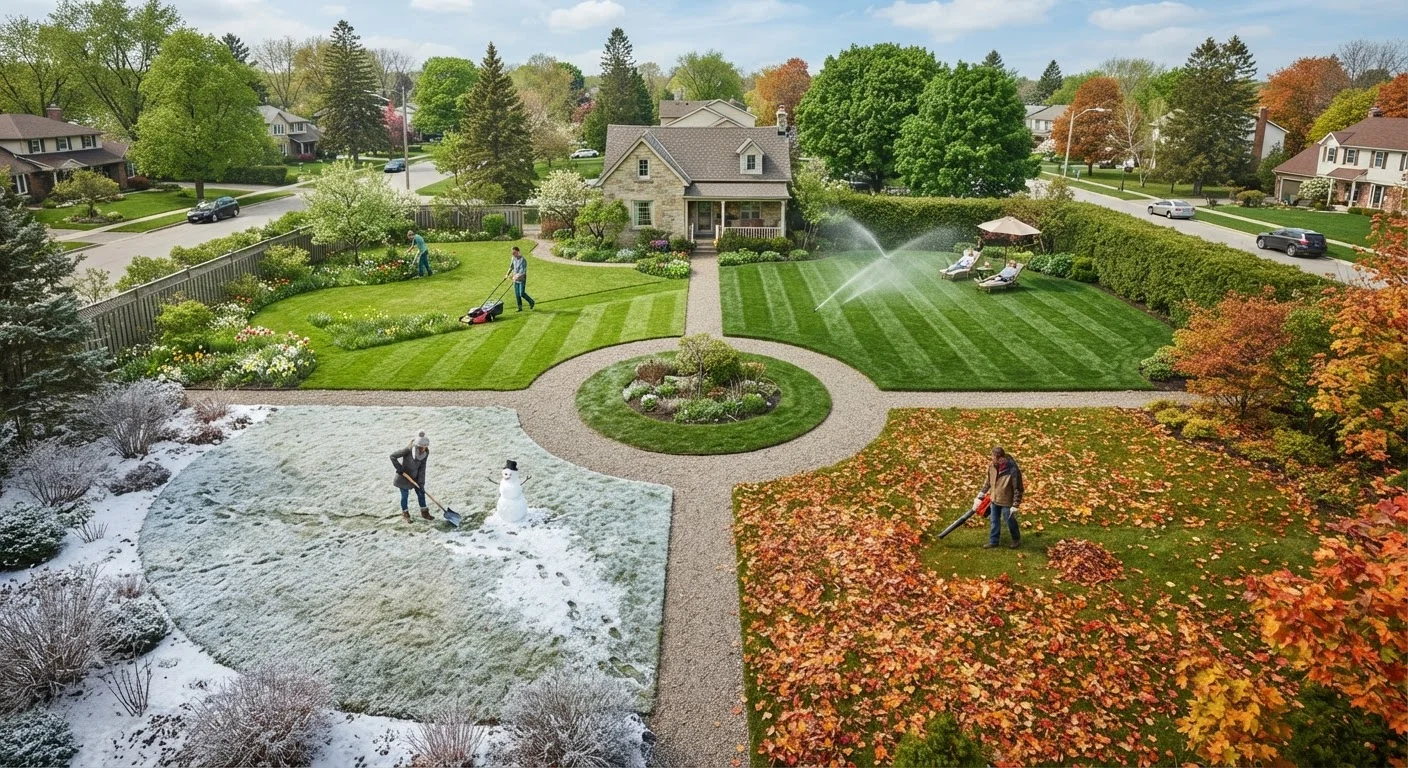
Spring (March-May): Wake-Up and Feed
Early spring is the time to rake out winter debris and thatch - the spongy mat of dead grass that blocks water and nutrients. Wait until the soil is firm enough to walk on without leaving deep impressions before you begin any mechanical work.
- Fertilize (late spring): Apply a balanced or slightly nitrogen-heavy fertilizer once soil temperatures reach about 55 °F. Fertilizing too early feeds weeds before grass has rooted.
- Overseed bare patches: Spring soil warmth helps seed germinate quickly. Rake lightly, spread seed, and keep the area moist for two to three weeks.
- Pre-emergent weed control: Apply pre-emergent herbicide before soil temperatures reach 55 °F - the point at which crabgrass typically germinates. Note: pre-emergent also inhibits grass seed, so don't overseed and apply pre-emergent at the same time.
- Begin mowing: Start when grass reaches about 3-4 inches; never remove more than one-third of the blade height at a time. See common lawn care myths for why cutting too short is counterproductive.
Summer (June-August): Protect and Conserve
Summer stresses cool-season lawns hard. Heat and drought push grass into a semi-dormant state - and that's okay. Fighting dormancy with heavy fertilizer and water actually weakens the lawn over time.
- Mow high: Raise your mower deck to 3.5-4 inches. Taller blades shade the soil, reduce evaporation, and crowd out weeds naturally.
- Water deeply and infrequently: About 1 inch of water per week (including rainfall) encourages deep root growth. Morning watering reduces fungal risk. For a full irrigation primer, see garden watering principles.
- Skip summer fertilizer on cool-season grass: Nitrogen push during heat stress invites disease and burn. Hold off until early fall.
- Watch for grubs: White grubs feed on roots through midsummer. Irregular brown patches that lift like loose carpet are a telltale sign; consult your local cooperative extension office for treatment timing.
Fall (September-November): The Most Important Season
Fall is the single most productive lawn care window for cool-season grass. Mild temperatures, reliable moisture, and reduced weed pressure create ideal conditions for root building.
- Aerate: Core aeration - removing small plugs of soil - relieves compaction, improves drainage, and allows fertilizer to reach roots. Rent a core aerator or hire a professional; spike aerators are less effective.
- Overseed: Spread seed immediately after aeration so seed falls into the holes. This is the most reliable way to thicken a sparse lawn.
- Fertilize: A fall fertilizer application, ideally with a higher potassium ratio, helps the lawn store energy for winter survival. Apply about 6 weeks before the ground freezes.
- Keep mowing until growth stops: Grass left too long over winter can mat and harbor snow mold fungal disease. Gradually lower the deck for your last two or three cuts of the season.
- Leaf management: Mulch light layers of leaves with a mower rather than bagging - they add organic matter. Thick leaf blankets left all winter can smother grass.
Fall lawn work pairs well with a broader seasonal home checkup; see our seasonal home maintenance checklist for other high-priority fall tasks.
Winter (December-February): Rest and Plan
For cool-season lawns in most of the U.S., winter is a rest period. Grass is dormant and foot traffic compacts soil without the plant's natural ability to recover - so stay off frozen or dormant turf when possible.
- Service your equipment: Sharpen mower blades, change oil, and replace the air filter during the off-season so you're ready in March.
- Test your soil: Send a soil sample to your local extension lab. Results take a few weeks and give you pH and nutrient data to guide spring fertilizing. Most cool-season grasses prefer a pH of 6.0-7.0.
- Plan ahead: Review which areas struggled last season - compaction, shade, drainage - and research solutions before spring arrives.
Aeration
The process of perforating the soil with small holes (core aeration) or spikes to reduce compaction and allow air, water, and nutrients to penetrate to the root zone.
Thatch
A tightly intermingled layer of living and dead grass stems, roots, and debris that accumulates between the soil surface and green grass blades. A layer thicker than ½ inch can block water and nutrients.
Overseeding
Spreading grass seed over an existing lawn - without fully tearing it up - to fill in bare or thin areas and improve turf density.
Pre-emergent herbicide
A weed-control product that prevents seeds from germinating. Applied before weeds sprout, it creates a chemical barrier in the soil - but it also inhibits grass seed, so timing is critical.
Dormancy
A natural slow-down state that grass enters during extreme heat or cold. The plant conserves resources by stopping visible growth while keeping roots alive.
Cool-season grass
Grass varieties that grow most actively in spring and fall when temperatures are between 60 °F and 75 °F. Examples include Kentucky bluegrass, tall fescue, and perennial ryegrass.