How Each Strategy Works
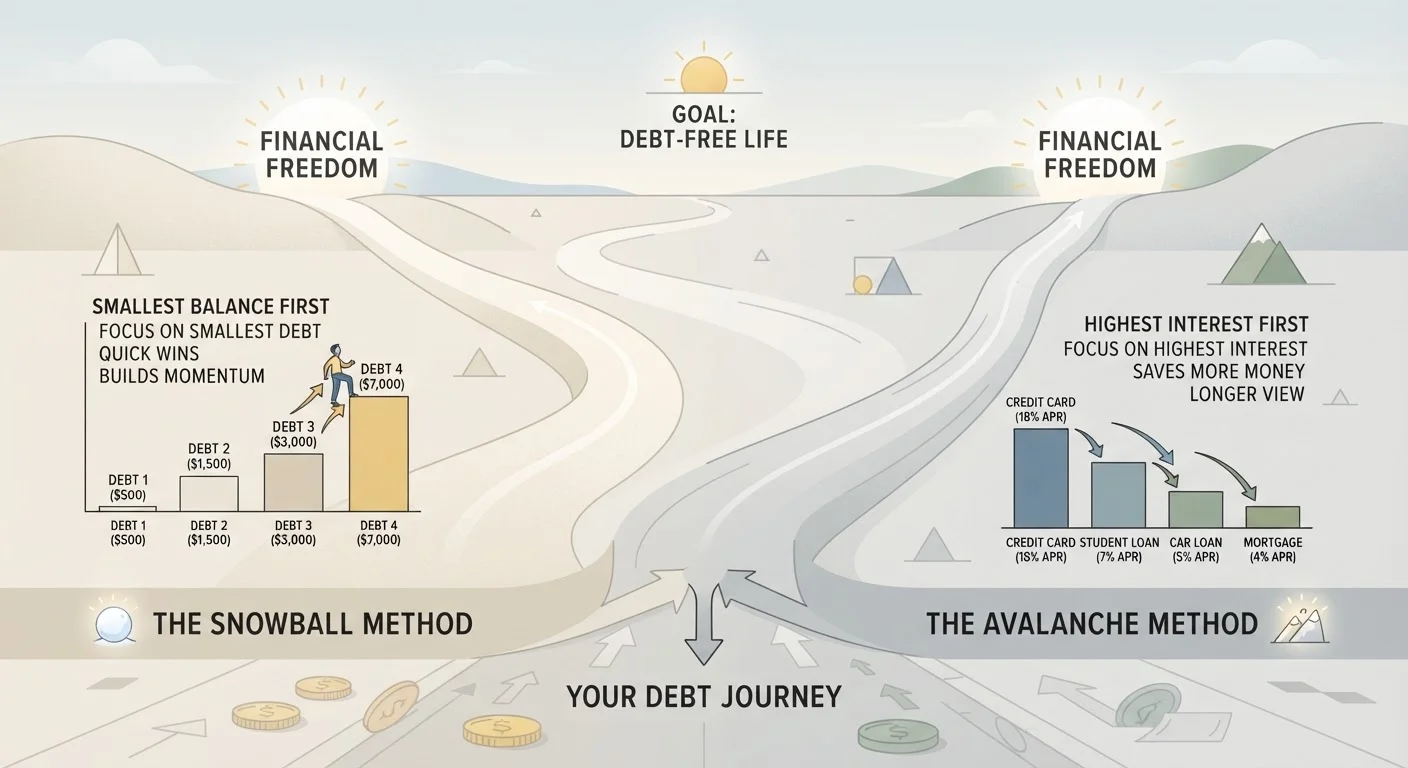
Both strategies share a common foundation: you make minimum payments on all debts, then direct any extra dollars toward one targeted debt. The difference is how you rank which debt gets that extra attention.
Debt Avalanche: You prioritize the debt with the highest annual percentage rate (APR), regardless of balance size. Once that account is paid off, you roll its payment into the next-highest-rate debt. This continues until all debts are cleared.
Debt Snowball: You prioritize the debt with the smallest outstanding balance, regardless of its interest rate. Each paid-off account frees up a payment that gets added to the next-smallest balance - creating a growing "snowball" of payment power.
Both methods harness the same mechanic: when one debt is eliminated, its minimum payment doesn't disappear from your budget - it gets redirected. That compounding payment momentum is what makes either strategy more effective than paying random amounts toward multiple debts simultaneously.
For a broader look at how these fit into overall debt management, see Understanding Credit and Debt from Every Angle.
The Math: What Each Method Actually Costs
In terms of total interest paid, the avalanche method nearly always wins. Because it eliminates high-rate debt first, less of your money accumulates interest over time. The difference can range from modest to significant depending on your balances, rates, and timeline.
Consider a simplified example: two debts - a $5,000 balance at 22% APR and a $1,200 balance at 8% APR - with $300 per month available after minimums. The avalanche approach (attacking the 22% debt first) would reduce total interest paid compared to the snowball approach (attacking the $1,200 balance first). The exact savings vary by situation, but the principle is consistent: higher-rate debt left unpaid grows faster.
That said, the snowball's "extra cost" is often smaller than people expect. Research published in the Journal of Consumer Research has examined how psychological factors affect debt repayment behavior, finding that account elimination - not just balance reduction - tends to motivate continued effort.
| Debt Avalanche | Debt Snowball | |
|---|---|---|
| Priority order | Highest interest rate first | Smallest balance first |
| Total interest paid | Lower - mathematically optimal | Slightly higher in most cases |
| Time to first payoff | Potentially longer if top debt is large | Faster - targets smallest balances |
| Motivational impact | Depends on patience and discipline | Strong early wins boost momentum |
| Best debt profile | Wide rate gaps between debts | Many small balances across accounts |
| Complexity | Requires tracking APRs carefully | Simple - sort by balance size |
This article is for general informational purposes only and does not constitute personalized financial advice. Consult a qualified financial professional for guidance suited to your specific situation.
The Psychology: Why Motivation Matters
Financial plans are only as effective as a person's ability to follow through on them. The snowball method exists precisely because behavioral consistency often outweighs optimal math in real-world outcomes.
Paying off a $900 credit card balance in two months produces a concrete result: one fewer bill, one fewer account to track, and a measurable sense of progress. That experience can reinforce the habit of continued repayment. The avalanche, by contrast, might not produce a fully paid account for a year or more if the highest-rate debt carries a large balance - which can feel discouraging.
Neither experience is universal. Some people find clarity and motivation in knowing they're minimizing cost. Others need early wins to sustain effort. Honest self-assessment matters more than defaulting to the "smarter" strategy on paper.
Hybrid Approach: Start Snowball, Switch to Avalanche
Some people find success by paying off one or two small debts first to build momentum, then shifting to the avalanche method for the remaining higher-rate accounts. This isn't a formal strategy, but it acknowledges that motivation and math don't have to be mutually exclusive. Track your progress in a simple spreadsheet and reassess every few months.
When to Consider Other Approaches
Debt avalanche and snowball methods assume your debts stay as-is - same rates, same terms. Debt consolidation is a separate approach that restructures what you owe, potentially lowering your interest rate or simplifying multiple payments into one. It carries its own trade-offs. Our article on Debt Consolidation: Trade-Offs Worth Understanding provides a balanced look at when it may or may not help.
It's also worth noting that debt repayment competes with other financial priorities, including building an emergency fund and saving for retirement. Automating your finances can help balance these goals - though automation has its own considerations, as explored in The Trade-offs of Automating Your Savings.
Large fixed debts - like a mortgage or auto loan - are generally handled separately from revolving or high-interest consumer debt. If you're weighing major financial commitments, related comparisons like Owning vs. Renting can provide useful context for the full picture of your financial obligations.