
The Myth of a Single National Housing Market
When national headlines announce that home prices rose or fell by a certain percentage, it's easy to assume that trend applies equally everywhere. It doesn't. The United States contains thousands of distinct housing markets - each shaped by its own economic base, population dynamics, land constraints, and local policy. What happens in San Francisco has little bearing on what happens in Cleveland, and neither tells you much about Boise or Birmingham.
For anyone making a housing decision - buying, selling, or renting - understanding why prices move differently across regions is more useful than tracking national averages. The forces that drive your local market are the ones that actually matter. See our plain-language overview of how the US housing market works for foundational context before diving into regional differences.
Local Jobs Are the Engine of Housing Demand
Employment is the single most reliable driver of sustained housing demand. When a region adds well-paying jobs - through tech expansion, manufacturing investment, healthcare growth, or a diversified economy - it attracts workers who need housing. That demand pushes prices up, particularly if the housing supply can't expand fast enough to absorb new residents.
Conversely, regions that lose major employers or experience prolonged industrial decline often see flat or falling home values, even during periods of national price growth. The Rust Belt's long price stagnation compared to coastal tech hubs is a clear historical illustration of this divergence.
~$400K+
Median home price gap between highest and lowest cost US metros
National Association of Realtors data consistently shows median home prices in the most expensive US metros exceeding those in the most affordable by several hundred thousand dollars, reflecting structural supply and demand divergence.
70%+
Share of US residential land zoned single-family only in many cities
Research from urban planning scholars has found that in numerous major American cities, the majority of residential land is restricted to single-family homes, limiting the overall housing supply response to demand growth.
Millions
Americans who relocated to new metros during remote work expansion
U.S. Census Bureau and moving industry data documented significant net population shifts from high-cost coastal metros to Sun Belt and Mountain West cities during the early-to-mid 2020s, visibly influencing local home prices in destination markets.
Migration patterns amplify employment-driven demand. When remote work became broadly feasible, many workers relocated from high-cost coastal metros to more affordable Sun Belt and Mountain West cities - bringing their incomes with them. Destination markets absorbed rapid demand spikes that dramatically outpaced local wage levels. The demographic forces reshaping US housing demand article explores how age cohorts and lifestyle shifts further layer onto these migration patterns.
Supply Constraints: Why Zoning Matters More Than Most Buyers Realize
Demand explains why people want to live somewhere. Supply constraints explain why prices don't simply adjust to meet that demand. In many of America's most expensive markets, it is extraordinarily difficult to build new housing. The primary culprit is local zoning law.
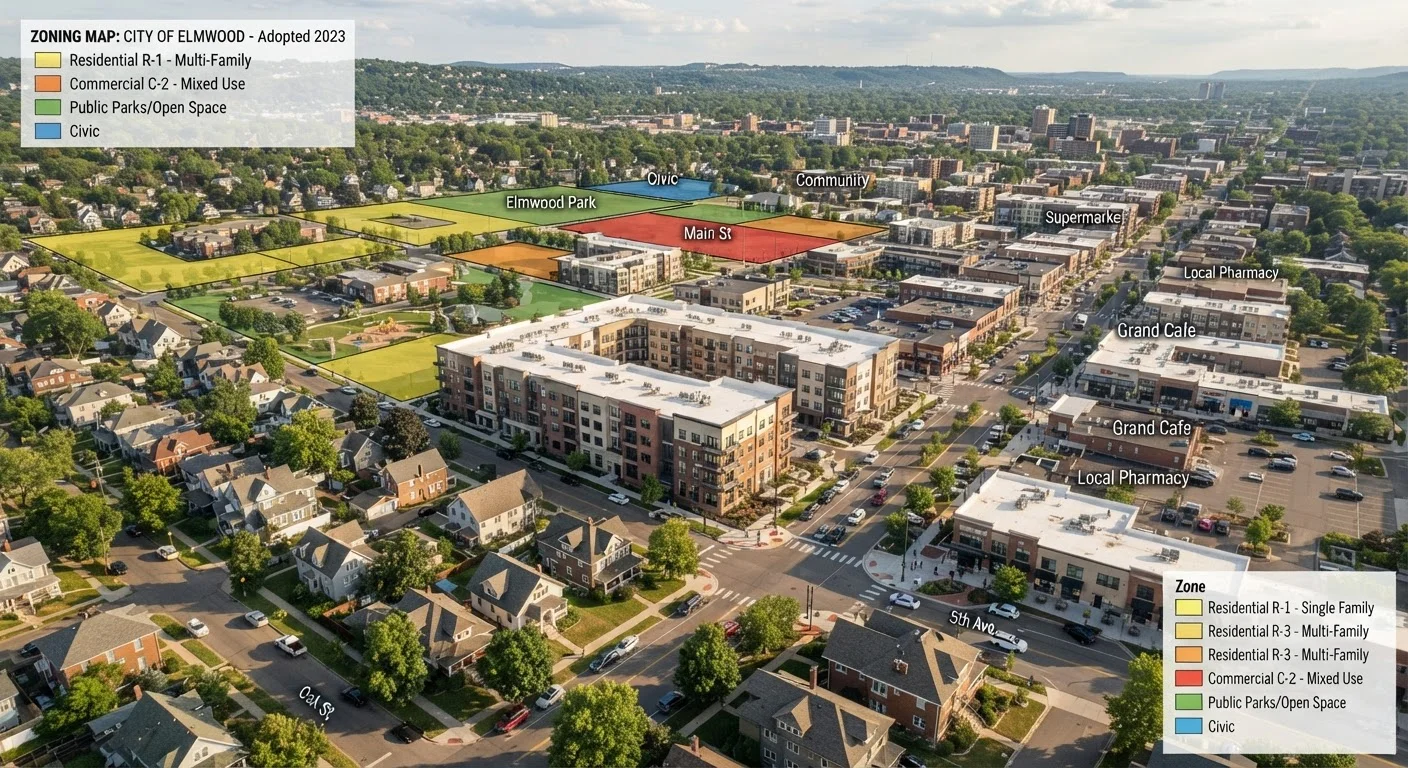
Single-family-only zoning - which prohibits apartments, duplexes, or townhomes on most residential land - severely limits how many homes a community can add. When population grows but the housing stock can't keep pace, existing homes become scarcer and more expensive. This is a defining feature of high-cost coastal metros. For a deeper look at how these rules work, see our article on how zoning laws influence home prices and housing availability.
By contrast, markets in the South and parts of the Midwest have historically allowed more flexible construction - more land, fewer restrictions, faster permitting. That additional supply capacity acts as a natural price moderator, even when demand is strong.
National Rates, Local Impact
Mortgage interest rates are set by national and global capital markets, not by local conditions. When rates rise sharply, monthly payments increase across every market simultaneously. But the effect on prices isn't uniform. In a high-demand, supply-constrained city, rate increases may slow price growth without reversing it - too many buyers still compete for too few homes. In a weaker market with adequate supply, the same rate increase can tip prices into decline.
Rate sensitivity also varies by buyer demographics. Markets with a higher share of all-cash buyers - often luxury or investor-heavy segments - are less sensitive to rate swings than markets where most buyers depend on financing. Our explainer on how mortgage interest rates shape the broader housing market walks through this chain reaction in detail.
It's also worth noting that seasonal patterns interact with these market fundamentals differently depending on location - a dynamic worth understanding before timing any major housing move.
What This Means for Housing Decisions
Recognizing regional price variation isn't just an academic exercise - it directly informs real decisions. A buyer relocating from a high-cost market to a more affordable one may carry price expectations that don't match local reality. A homeowner in a supply-constrained market may hold more equity resilience during downturns than one in an oversupplied region. Renters in cities with recent demand surges may face affordability pressures that national figures understate.
Urban, suburban, and rural markets also behave in meaningfully different ways - see our side-by-side comparison of urban, suburban, and rural housing markets to understand those structural differences. The most useful frame for any housing decision is a clear-eyed look at the specific local forces at work - employment trajectory, population trends, housing supply capacity, and zoning policy - rather than national headlines alone.
This article is intended for general informational purposes only and does not constitute financial, legal, or real estate advice. Readers should consult a qualified real estate professional for guidance specific to their situation and local market.