Why These Three Words Are Everywhere - and Mean Almost Nothing
Walk down any grocery, hardware, or personal care aisle and you'll see them: "natural," "non-toxic," "eco-friendly." They appear on cleaning sprays, baby shampoos, paint cans, snack foods, and lawn fertilizers. They feel reassuring. That's exactly the point.
The uncomfortable truth is that for most product categories, none of these terms carries a standardized federal definition. A manufacturer can print "100% Natural" on a label without any independent verification, regulatory approval, or agreed-upon benchmark. This practice - often called greenwashing - is the use of environmental or health-adjacent language to imply benefits that aren't independently confirmed.
The Federal Trade Commission (FTC) publishes what are known as the Green Guides, a set of guidelines covering environmental marketing claims. The guides advise companies against broad, unqualified claims like "eco-friendly" and recommend that any specific claim be substantiated. However, the Green Guides are guidance documents - not binding regulations - and they don't cover health claims like "non-toxic" or "natural" comprehensively. For a deeper look at which product claims come with actual legal obligations, see what manufacturers are legally required to disclose.
Myth
"Natural" means the product is safer, purer, or healthier than conventional alternatives.
Fact
"Natural" has no legally binding federal definition for most consumer products; it signals nothing about safety, purity, or health outcomes.
The FDA has considered but never finalized a formal definition of "natural" for food labeling. For cosmetics and household products, no universal federal standard exists at all. Arsenic, mercury, and many known allergens are entirely natural substances - origin in nature has no bearing on safety profile. A product labeled "natural" may still contain synthetic preservatives, processed derivatives, or ingredients that trigger reactions in sensitive individuals. The label reflects a marketing choice, not a regulatory finding.
Myth
"Non-toxic" means the product has been tested and confirmed safe for humans and the environment.
Fact
There is no federal standard defining "non-toxic" for general consumer products; any company can use the term without independent testing.
Unlike pharmaceuticals, which require pre-market safety data, most household and personal care products face no mandatory pre-market toxicity testing before going to market. "Non-toxic" on a label reflects the manufacturer's own internal judgment - which may or may not be backed by any testing at all. Toxicity is also dose- and context-dependent: a substance that is harmless in trace amounts may be harmful in higher concentrations or for specific populations such as children, pregnant individuals, or people with certain health conditions. Always consult a healthcare professional about product safety concerns for vulnerable household members.
Myth
"Eco-friendly" or "environmentally friendly" means the product is genuinely better for the planet.
Fact
The FTC's Green Guides warn against unqualified environmental claims, but compliance is voluntary and enforcement is limited.
The FTC's Green Guides specifically flag broad terms like "eco-friendly" and "environmentally friendly" as potentially deceptive if unqualified, because no product has zero environmental impact. A product might reduce one environmental harm (say, reduced packaging) while creating others (energy-intensive manufacturing, non-recyclable components). Without a qualifying explanation - what makes it eco-friendly, and compared to what? - the term is effectively meaningless. The Green Guides encourage specificity, but because they aren't enforceable regulations, many manufacturers continue using sweeping language without consequence.
Myth
If a product is certified "USDA Organic," it means all ingredients are natural and chemical-free.
Fact
USDA Organic certification has a defined standard, but it permits certain approved synthetic substances and does not mean "chemical-free."
USDA Organic is one of the more rigorous and transparent claims in the consumer market - it does involve third-party auditing and a published National List of allowed and prohibited substances. However, "organic" refers to how ingredients were grown and processed, not to the absence of all synthetic compounds. Some synthetic substances are permitted on the National List. Additionally, a product labeled "made with organic ingredients" need only contain 70% organic content. "Chemical-free" is a scientifically impossible claim - everything, including water, is a chemical. When evaluating organic claims, specificity and context matter more than the word itself.
Myth
Products marketed as "green" or "natural" are always better choices than conventional products.
Fact
Product quality, safety, and environmental impact depend on formulation and testing - not marketing language or aesthetic packaging.
A conventional product with transparent ingredient disclosure, third-party safety testing, and verified environmental performance data may be a more informed purchase than a "natural" alternative with opaque sourcing and no external verification. Consumer decisions grounded in certifications, ingredient transparency, and independent testing tend to be more reliable than those driven by front-label terms. This doesn't mean all green-marketed products are inferior - many are formulated responsibly - but the label alone is not evidence of that. Healthy skepticism and a focus on verifiable information lead to better outcomes than brand feel or visual cues.
How to Shop More Skeptically Without Becoming Paralyzed
Understanding what these terms don't guarantee is only half the work. The practical next step is knowing what actually does carry weight.
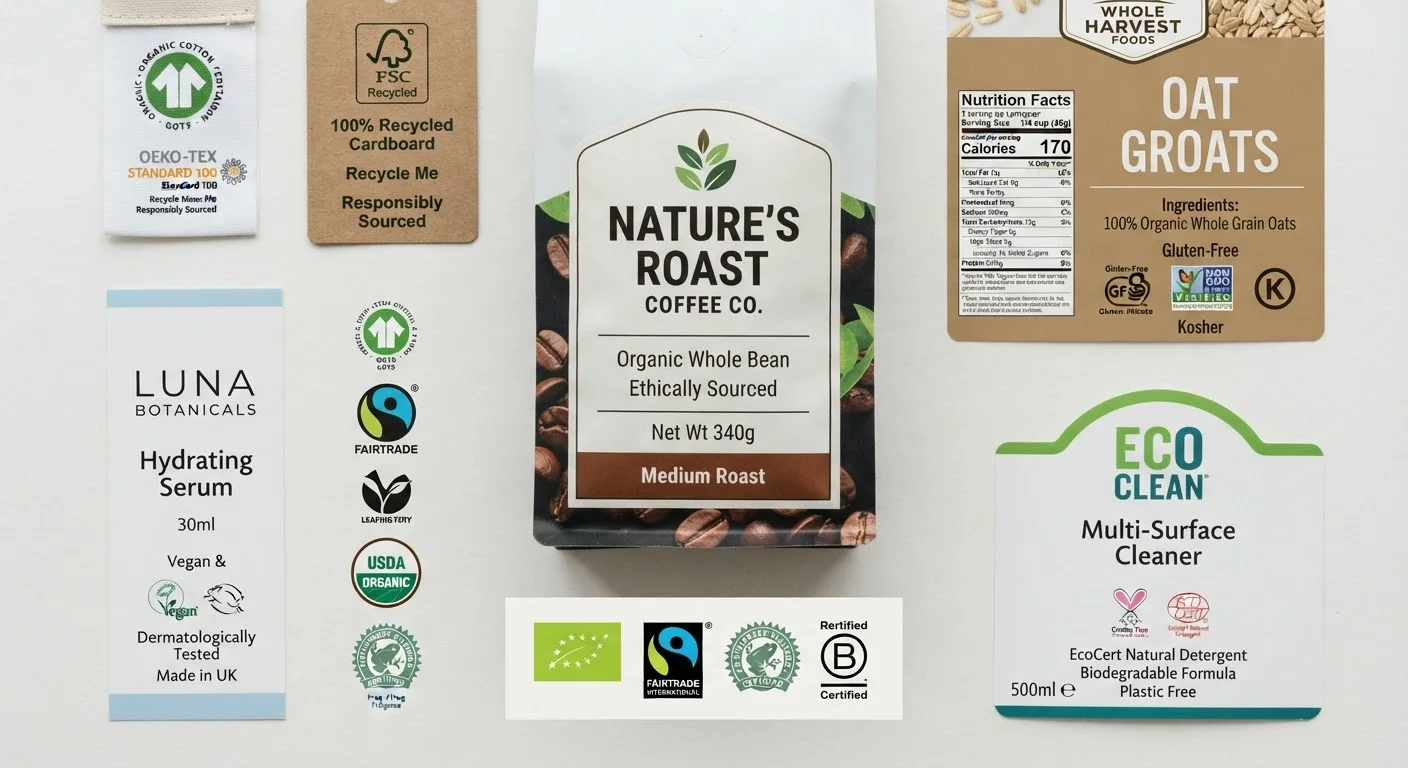
Look for third-party certifications. Bodies like the Environmental Protection Agency's Safer Choice program, NSF International, and the USDA Organic designation involve actual testing, auditing, or ingredient review - not self-declaration. These aren't perfect, but they involve outside accountability. For a breakdown of which certifications are worth trusting versus which are largely self-awarded badges, see our guide on certifications worth trusting on consumer products.
Read the ingredient list, not the front of the package. The front label is marketing real estate. The ingredient list - where it exists - is where actual product composition lives. Full ingredient disclosure is not uniformly required across all product categories in the U.S., which means gaps remain. Marketing copy is designed to persuade, not inform; reading between the lines of a product description can help you spot what's often left unsaid.
Treat vague claims as an invitation to ask questions. If a company makes a broad environmental or health claim, look for a specific explanation on their website. Credible brands typically back up claims with data, certifications, or methodology. Silence or circular language - "made with the earth in mind" - is not evidence of anything.
Just as "Made in the USA" has a specific FTC legal standard that most consumers misunderstand, these green and health-adjacent terms operate in a similarly murky space. Understanding the pattern helps. See how similar dynamics play out with common misconceptions about "Made in the USA" claims.
This article is for general informational and educational purposes only. It does not constitute medical, legal, or regulatory advice. Consult a qualified professional for guidance specific to your circumstances.