Why Bins Are Rarely the Real Answer
Walk into any big-box store and an entire aisle promises to solve your clutter problem - if you just buy the right container. It's a compelling story, but it's usually backwards. Storage products are tools for organizing things you've already decided to keep, in a space you've already assessed. Used without that foundation, they become clutter themselves.
If you're feeling the urge to buy more storage, that instinct is worth pausing on. The questions below - and the common mistakes they help you avoid - can save you money, time, and a closet full of bins that never quite worked. If you're just beginning to think about organization overall, our beginner's guide to home organization is a helpful starting point.
The Mistakes That Send Shoppers Back to the Store
Most failed organization attempts share a recognizable pattern: something is purchased, installed, and used briefly - then abandoned. The mistakes below explain why that cycle keeps repeating, and what to do instead.
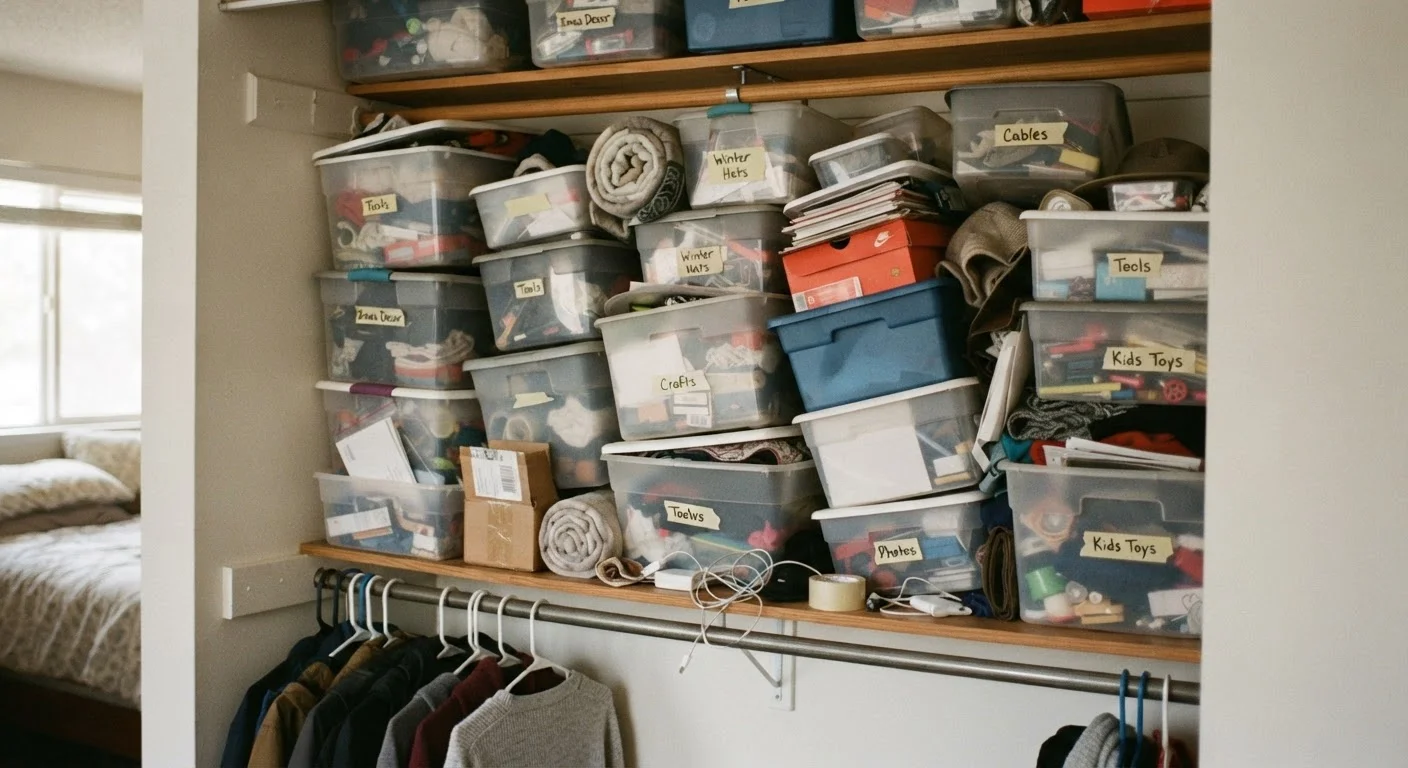
Buying storage bins before sorting through what you already own.
Why it happens: When a space feels chaotic, purchasing something feels like taking action - it's faster and more satisfying than the slower work of sorting.
Choosing containers without measuring the space they'll go into.
Why it happens: Bins look roughly right in the store aisle or in a product photo, so shoppers skip the tape measure and guess.
Organizing for an idealized version of your habits rather than your real ones.
Why it happens: People envision how they want to behave - not how they actually do - when setting up systems, leading to structures that feel aspirational but quickly break down.
Storing items in a location that doesn't match where they're actually used.
Why it happens: Organizing advice often emphasizes tidy aesthetics over functional placement, leading people to hide things away rather than stash them nearby.
Assuming any clutter problem is a storage problem.
Why it happens: Storage products are heavily marketed as solutions to disorganization, so it's natural to conflate the two - even when the real issue is simply owning too much.
Buying mismatched bins in multiple sizes without a clear plan.
Why it happens: Shoppers grab what looks useful in the moment, accumulating an assortment that doesn't stack, group, or label consistently.
For a broader look at how to evaluate any home purchase before making it, the pre-purchase checklist for everyday shoppers walks through questions worth asking before spending on anything significant.
Building a System That Actually Holds
Declutter Before You Store Anything
Purchasing storage before removing unwanted items is one of the costliest mistakes in home organization. You will simply pay to house things you no longer need. Always complete a thorough sort and purge of a space before deciding what containers, if any, are truly required.
Once you've sorted, purged, measured, and mapped your real habits, you're finally ready to think about containers - and you may find you need fewer than expected. The goal is a system your whole household will maintain, not one that requires constant effort to uphold. If multiple people share the space, it helps to account for different tidiness styles; our piece on organizing shared spaces for different standards covers that dynamic directly.
For rooms with limited square footage, also consider whether you're making full use of vertical storage before adding floor-level bins. The comparison of vertical versus floor-based storage can reframe how you see a constrained room. And when you're ready to tackle every room systematically, the whole-home organization framework offers a room-by-room structure to guide the full project.
The measure of a good storage system isn't how it looks on day one - it's how effortlessly it maintains itself six months later.