
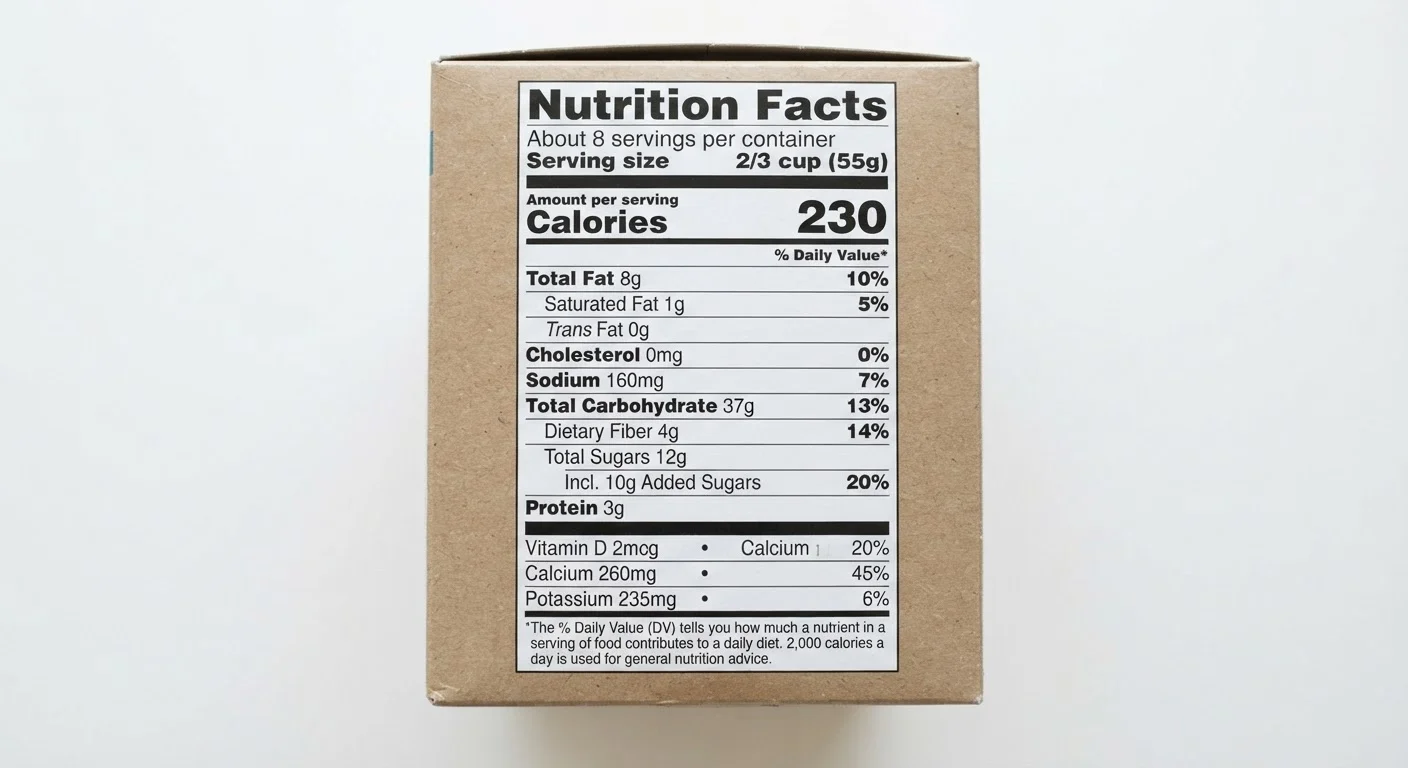
Why the Label Exists and Who Regulates It
The Nutrition Facts label is required on most packaged foods sold in the United States and is regulated by the U.S. Food and Drug Administration (FDA). Its purpose is straightforward: give consumers consistent, comparable information about what's inside a product before they eat it. The current label format was updated in 2016 and phased in by 2020, reflecting advances in nutrition science and changes in public health priorities.
Because the label is standardized by federal regulation, the same categories appear in the same order on every product - making it one of the most reliable pieces of information on any package. For a broader look at which product claims are regulated versus which are largely marketing, see what product labels are actually telling you.
Serving Size
The standardized reference amount of food on which all label values are based. Determined by the FDA based on typical consumption patterns, not a recommended intake level.
% Daily Value (%DV)
A percentage showing how much of a nutrient one serving contributes toward a general daily reference total, based on a 2,000-calorie daily diet. Used for quick comparison between products.
Added Sugars
Sugars and syrups added to a food during processing or preparation, distinct from naturally occurring sugars found in fruits, vegetables, or dairy.
Dietary Fiber
A type of carbohydrate the body cannot fully digest. Associated with digestive health, blood sugar regulation, and cardiovascular health.
Saturated Fat
A type of fat found mainly in animal products and some tropical oils. Dietary guidelines generally recommend keeping intake limited as part of a heart-healthy diet.
Trans Fat
An artificially produced fat formed through partial hydrogenation of oils. The FDA has largely eliminated artificial trans fats from the U.S. food supply, though trace amounts may still appear.
Serving Size: The Number That Changes Everything
The serving size appears at the very top of the label, and every other number on the label is calculated based on it. Critically, serving size reflects how much people typically eat in one sitting - not necessarily a recommended amount. The FDA revised serving sizes in 2016 to more closely match real consumption patterns, so many products now show larger serving sizes than they did previously.
If a bag of chips lists a serving size as 1 ounce (about 28 grams) but you eat 2 ounces, every value on the label - calories, sodium, fat - must be doubled in your estimate. Servings per container, listed just below serving size, tells you how many of those portions are in the whole package.
| Label Regulator | U.S. Food and Drug Administration (FDA) |
| Current Format Introduced | 2016 (fully phased in by 2020) (FDA) |
| Calorie Reference Diet | 2,000 calories per day (standardization benchmark) (FDA) |
| "Low" Nutrient Threshold | 5% Daily Value or less per serving (FDA guidance) |
| "High" Nutrient Threshold | 20% Daily Value or more per serving (FDA guidance) |
| Required Micronutrients Listed | Vitamin D, Calcium, Iron, Potassium (FDA (updated 2016 rule)) |
Calories, Macronutrients, and What the Numbers Mean
Calories measure the total energy a serving provides. Below that, the label breaks down the three macronutrients: total fat, total carbohydrate, and protein. Each is listed in grams. Fat is further broken into saturated fat and trans fat - both linked to cardiovascular health considerations. Carbohydrates are broken into dietary fiber and total sugars, with added sugars listed as a distinct subcategory. Added sugars are those introduced during processing, not naturally occurring ones found in fruit or dairy.
To understand what each macronutrient actually does in your body, macronutrients explained is a useful companion read. Fiber deserves particular attention - it's a carbohydrate subtype that most Americans fall short on; fiber: the nutrient most Americans aren't getting enough of explains why it matters.
% Daily Value: A Benchmark, Not a Prescription
The % Daily Value (%DV) column on the right side of the label shows how much of a nutrient one serving contributes toward a general daily reference amount. These reference amounts are based on a 2,000-calorie-per-day diet - a benchmark chosen for standardization, not as a universal recommendation. Your actual needs depend on age, sex, activity level, health status, and other factors.
A practical rule of thumb: 5% DV or less is generally considered low for a nutrient; 20% DV or more is generally considered high. This makes it easy to scan labels and compare products - look for higher %DV on nutrients you want more of (fiber, vitamins, minerals) and lower %DV on those worth limiting (sodium, saturated fat, added sugars).
The label is required to list vitamin D, calcium, iron, and potassium - nutrients identified as public health priorities in the U.S. For a plain-language breakdown of what these and other micronutrients do, see understanding vitamins and minerals.
Common Misreadings and How to Avoid Them
Several consistent misunderstandings trip up even attentive label readers. First, many people treat the calorie count as the only number worth checking and skip everything else - missing meaningful information about sodium, added sugars, or fiber. Second, it's easy to confuse total sugars with added sugars: a plain yogurt may show 12g total sugars that are entirely naturally occurring lactose, while a flavored yogurt may show 20g with 10g added. These are nutritionally distinct situations.
Third, some shoppers assume that a food labeled "low fat" or "light" is automatically a healthier choice - but these claims apply only to specific nutrients, and a low-fat product may still be high in added sugars or sodium. For a grounded look at how common nutritional assumptions fall apart under scrutiny, nutrition myths that won't seem to die is worth reading.
Finally, don't overlook the ingredient list, which appears separately below the Nutrition Facts panel. Ingredients are listed in descending order by weight - so if added sugar appears in the first three ingredients, it's present in significant quantity. Federal rules around ingredient disclosure are explained in detail at ingredient lists and material disclosures.
This article is for general informational and educational purposes only and is not a substitute for professional medical or dietary advice. Consult a qualified healthcare provider or registered dietitian for guidance specific to your health needs.